
Lesson 4: Meet the Organ’s Families of Sound
Explore the pipe organ’s principal families of sound—from warm Flutes and delicate Strings to bold Reeds, brilliant Mixtures, and some wonderfully unusual voices.
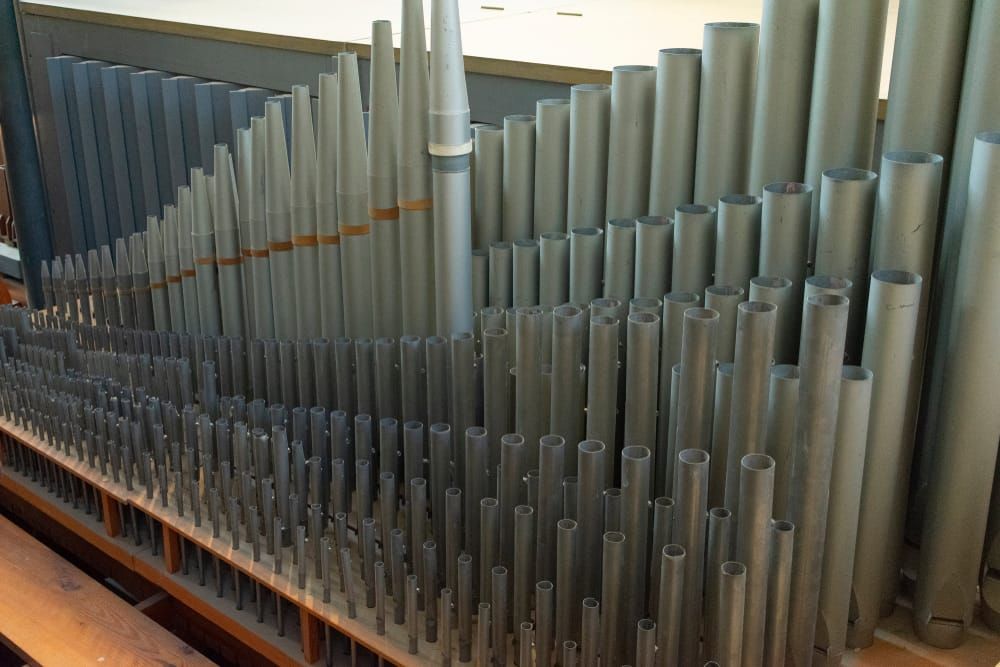
We've already discovered that an organist can change the character of the instrument by selecting different stops.
But with dozens—and sometimes hundreds—of stops available on a large organ, how do we begin making sense of them?
Fortunately, organ stops aren't simply a collection of unrelated sounds. Most belong to recognizable families.
Think of an orchestra.
We have strings, woodwinds, brass, and percussion. Each family has its own character, and individual instruments within the family have their own distinctive voices.
The organ works somewhat the same way.
Let's meet some of its principal families.
Principals — The Organ's Own Voice
We'll begin with the Principal, sometimes called the Diapason.
Unlike a Flute or an Oboe stop, a Principal isn't primarily trying to remind us of another instrument.
It sounds like an organ.
Principals form the foundation of the traditional pipe-organ sound. Their tone is clear, strong, and focused, and they can be combined at different pitches to create the brilliant sound many listeners immediately associate with a pipe organ.
If someone asked, “What does a pipe organ sound like?” the Principal family would be a very good place to begin.
Flutes — Warmth and Gentleness
Flute stops generally have a softer, rounder quality.
Some can sound delicate and almost intimate. Others are fuller and warmer. Because there are many different kinds of Flute stops, organists can use them in everything from a quiet solo passage to a larger combination of sounds.
When you hear a particularly gentle passage of organ music, there's a good chance a Flute may be somewhere in the registration.
Strings — Delicate and Expressive
The organ's String stops tend to have a thinner, more delicate quality.
They don't literally reproduce the sound of a violin or cello. Instead, their tonal character suggests something of the expressive quality we associate with orchestral strings.
String stops can be especially effective when an organist wants a quieter, more lyrical color.
Reeds — A Different Kind of Pipe
Then we come to the Reeds.
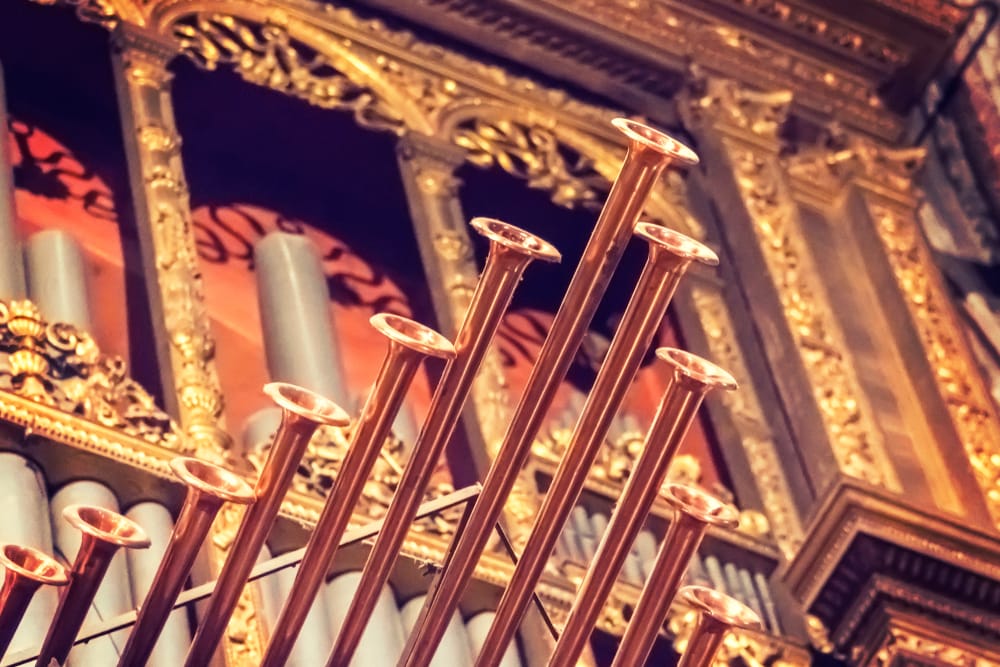
These include stops with names such as Trumpet, Oboe, Clarinet, and Trombone. Their distinctive, penetrating sound can add everything from a colorful solo voice to tremendous brilliance and power.
Reed pipes also produce their sound differently from the organ's flue pipes—a distinction we'll encounter when we look more closely at how the instrument works.
For now, simply listen for their distinctive personality.
A Trumpet announcing itself over the rest of the organ can be difficult to miss.
Mixtures — One Key, Several Pipes
Now things become especially interesting.
A Mixture is a compound stop.
When the organist presses one key, several ranks of pipes can sound together. These additional pitches reinforce upper harmonics and add brilliance and complexity to the organ's sound. Mixtures are particularly important in creating the bright, full ensemble associated with much traditional organ music.
If you look at an organ console, you may see a Mixture identified with a Roman numeral. That numeral can indicate how many ranks are associated with the stop.
So one stop doesn't necessarily mean one pipe sounding for every key.
The organ likes to keep things interesting.
Pavla Salvová & Jan Rotrekl — Variations on an Original Theme by Denis Bédard
Mutations — What's That Fraction Doing There?
Sooner or later, someone examining an organ console notices a stop marked with an unusual number.
Perhaps instead of the familiar 8' or 4', there's a fraction.
Welcome to the world of Mutation stops.
Mutations sound pitches related to the note being played rather than simply reproducing that note at another octave. They reinforce particular harmonics—such as a fifth or a third—and can add striking colors when combined with other stops.
You don't need to understand the mathematics to enjoy the result.
Just remember:
When you see those funny fractions, something colorful may be about to happen.
And Then There Are the Oddballs
Not every stop fits neatly into the sounds we've just discussed.
Some organs contain voices that are simply fun to discover.
The Vox Humana, for example, is a Reed intended to suggest qualities of the human voice.
And then there's the Zimbelstern—a rotating star that produces shimmering bell-like sounds.
You aren't going to find a Zimbelstern on every organ.
But when you do, you're probably going to want to hear it.
Every Organ Has Its Own Palette
Here's where everything we've learned becomes especially important:
Not every organ has the same stops.
A smaller instrument may accomplish a great deal with a relatively modest stoplist. A large cathedral or concert-hall organ may offer many variations within a single family.
Names can change, too.
A stop called a Principal in one tradition may be called a Diapason in another. Different countries and historical periods developed their own characteristic sounds and terminology—the original Listener's Companion points, for example, to French Bombarde reeds and the Italian Voce Umana.
That's why encountering an unfamiliar pipe organ can be such an adventure for an organist.
We don't merely ask:
How many stops does it have?
We want to know:
What voices does this particular instrument have to offer?
And now, when you're listening, you can begin asking the same question.
Can you hear the clarity of the Principals?
The warmth of a Flute?
The delicacy of Strings?
The distinctive character of a Reed?
The brilliance added by a Mixture?
You don't have to identify every stop by name.
Simply beginning to recognize that the organ has families of sound changes the way you listen.
But all those sounds raise another question.
We know the organist presses keys, plays pedals, and selects stops.
How does any of that actually make a pipe speak?
That's next.

Comments ()